Does the coffee you brew at home taste off and you’re not sure why? One of the most overlooked brewing parameters by home baristas is the coffee to water ratio.
As a broad standard, we recommend you start with the ratio of 1 unit of coffee to 15-18 units of water (1:15-18). This is called the Golden Ratio. Coffee connoisseurs around the world use this ratio, making it a popular ratio to start off with. It is a well-balanced and optimally extracts coffee, giving you the best chance of brewing a good cup of coffee.
Objectively speaking, there is no such thing as the best coffee to water ratio optimal for every brewing method. Depending on the flavors you want to extract, what beans you use, the brewing method, you should adjust the coffee to water ratio accordingly.
Here at the Coffee Coterie Company, we know brewing the best cup of coffee isn’t always a simple task. The coffee to water ratio can be mysterious and often trips up most home coffee brewers. To further complicate things, while browsing the internet, you may find many various calculators that can be more confusing than helpful.
In this article, we put together a comprehensive brewing guide coffee to water, backed by extensive research and personal accounts. We’ll explore the importance of this ratio and how it affects your cup. By breaking down the optimal ratio for each coffee brewing method, you’ll be equipped with the knowledge to find the best ratio that suits your tastes.
Keep scrolling to learn more and take charge of your coffee brewing technique by starting with the proper coffee to water ratio.
Skip ahead to the recommended coffee to water ratio for:
- Why Measuring Your Coffee And Water Matters
- Why Does Imbalanced Coffee Taste Gross?
- How To Measure Coffee and Water
- The Golden Ratio, Is It The Best?
- Coffee To Water Ratio By Brew Methods:
- Common Brewing Misconceptions
- Other factors To Consider When Brewing Coffee
- You Are a Coffee To Water Ratio Expert Now!
Why Measuring Your Coffee And Water Matters
Improperly brewed coffee is unpleasant. One of the sure signs of improperly brewed coffee is when your cup turns out too sour, too bitter, too watery, or just lacks depth. Without understanding the coffee to water ratio, you are most likely brewing imbalanced coffee with too much or too little coffee/water.
Using the correct coffee to water ratio means you will accurately extract the acids, sugars, aromas, spices, and bitter compounds from your coffee beans. When improper coffee extraction occurs, you could end up with a cup that is dominated by one or two of the flavor profiles, potentially leaving you with an overly sour cup of coffee that lacks the depth of flavor we love.
Understanding how much water to use with the proper amount of coffee grounds ensures you get a perfectly brewed cup. Once you learn how the brewing ratio works, you can apply the same method no matter how many cups you plan to brew.
Why Does Imbalanced Coffee Taste Gross?
We have all drank a lousy cup of coffee, and more often than not, it is caused by poor extraction.

Brewing a perfect cup of coffee is a balancing act. While brewing, the first compounds extracted from coffee are the acids characterized by sour/tangy flavors. The following compounds extracted are the sugars characterized by sweetness. Finally, the last to be extracted are the bitter compounds (1).
Each one of these flavor compounds plays a vital role in the final results. Having too much of one will result in a poor tasting cup. If you use too much water for the incorrect amount of coffee, you will either under or over-extract your coffee.
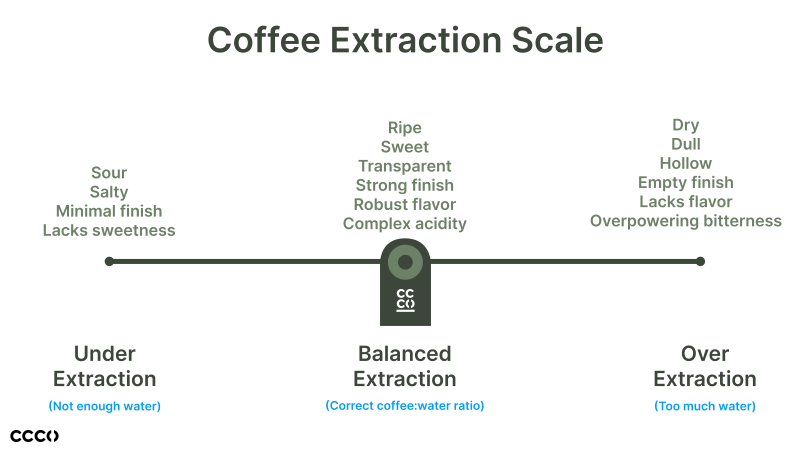
Underextracted coffee leaves the essential flavor compounds unextracted from your coffee grounds. It tastes sour, diluted, and watery. You will know when you have under-extracted your coffee when your cup leaves a sharp sensation on the side of your tongue.
Over extracted coffee occurs when you pull too many flavor compounds from your coffee beans. It tastes overly bitter with a dry sandpapery texture similar to black tea and dry wine (tannins). These flavors overpower the flavourful acids and sugars of your beans, leaving you with a hollow and bitter cup.
This helpful diagram illustrates the balance:
How To Measure Coffee and Water
One of the essential tools to have in your home coffee brewing setup is a kitchen scale. It takes the guessing out of your brewing technique as you can adjust and dial in on the proper coffee to water ratio, no matter how many cups you are brewing.
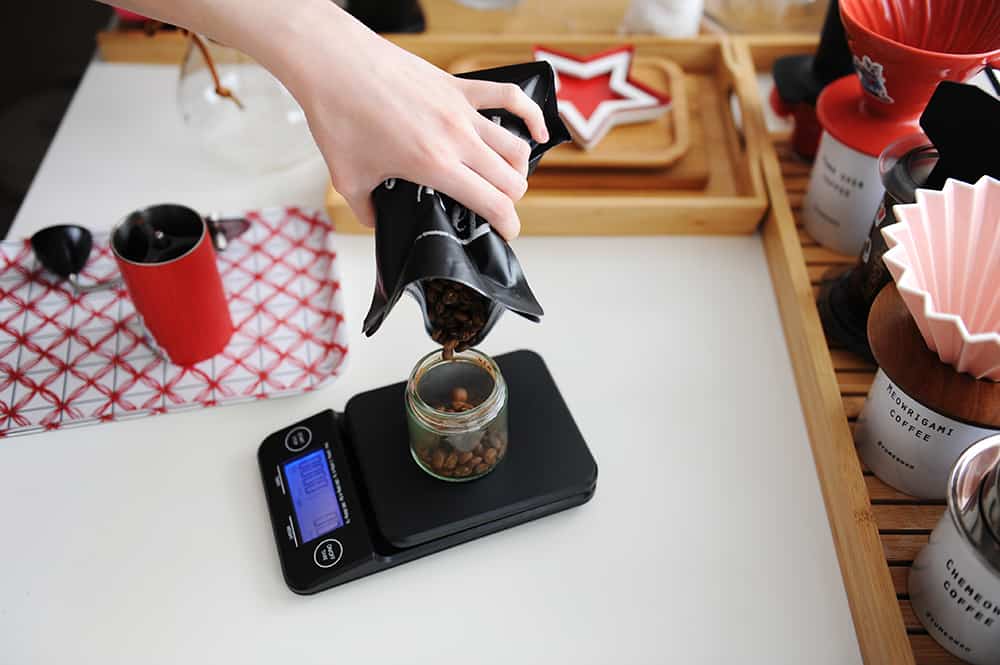
With your kitchen scale and brewing ratio, you will be able to measure out your beans and water. To keep things simple we will use the Golden Ratio of 1:15 in our step-by-step guide below.
How To Use Coffee To Water Ratios
The golden ratio means that for every 1 gram of coffee; 15 grams of water is needed. Using this 1:15 ratio and your kitchen scale, follow along with the steps below:
Pro tip: 1 g = 1 ml, so when measuring your water, you can use a measuring cup or your scale
If you know how much coffee you want to yield, here’s how to find your coffee to water ratio:

- Know how much coffee you want to make; you might have to measure this out with a measuring cup As an example, let’s use 250ml.
- Using the ratio and a calculator, divide your desired coffee amount by 15. This will give you the weight of beans you need in grams. For example, we’ll need 16.7 grams (250 divided by 15) of beans to yield our 250ml cup of coffee.
If you know the amount of beans you want to brew with, here’s how to figure out the amount of water to use:

- Measure the amount of coffee beans you would like to brew. As an example, let’s use 15 grams.
- Using the ratio and a calculator, multiply the amount of beans you have by 15. For example, we’ll need 225ml of water for our 15 grams of coffee (15 x 15 = 225).
The Golden Ratio, Is It The Best?
When it comes to coffee preference, there is simply no such thing as best. The Golden Ratio is a great rule of thumb and a good place to start.
As the most famous coffee to water ratio, The Golden Ratio is a formula derived by professor Lockhart of MIT in the 1950s. The ratio was derived from a series of surveys to determine American’s coffee preferences (2).
Though simple, the 1:15-18 ratio is versatile. If you’re looking to explore, here’s how it can be tweaked to your preference:
- 1:15 Ratio – This ratio calls for the least amount of water for every unit of coffee. With less water, coffee brewed with this ratio will be more concentrated and produce a richer and crisper acidic cup of coffee.
- 1:16 and 1:17 Ratio – This ratio falls within the middle of the Golden Ratios. It is the most popular one used in our office that yields a rich and balanced cup.
- 1:18 Ratio – This ratio uses the largest quantity of water for every unit of coffee. Coffee brewed with this ratio will yield weaker and more bitter coffee since more water results in more extraction. You will get a darker and rounded cup with a touch of acidity.
A slight adjustment to the ratio will yield a vastly different cup. It all depends on your taste preference and what type of beans you are brewing. Through trial and error, brew a few cups at different ratios and see how they taste. Find your favorite ratio and allow yourself to explore and learn!
Coffee To Water Ratio By Brew Methods:
Like dinner recipes, coffee recipes best serve as a guideline to get you in the ballpark of what might taste good to you. No such thing exists as perfect for everyone. Use these ratios for each brewing method as a guideline, developed lovingly through our brew tests and taste tests.
Feel free to adjust and tweak to your preference, don’t forget to share what ratio worked best for you below in the comments section.
Chemex Brewing Ratio – 1:17

Chemex’s original recipe calls for one rounded tablespoon of ground coffee (about 5 grams) for every 5 oz (148 ml). Many coffee drinkers, including us, found this ratio to be way too strong and bitter.
We found 1:17 to be the optimal ratio that produced a well-balanced cup the highlighted all the nuances of our coffee beans.
Pour Over & Drip Machine Ratio – 1:15

Whether you are using pour-over or an automatic drip machine, we recommend you start with a coffee to water ratio of 1:15. It will produce a crisp and balanced cup of coffee. If you prefer a bolder cup, we recommend you increase the ratio to 1:16 or 1:17.
Aeropress Ratio – 1:6
Alan Adler, the famous Aeropress inventor, recommends a 1:6 coffee to water ratio in his original recipe. It produces a coffee concentrate close to an espresso where you can add additional water or milk.
Alternatively, if you are looking to brew something more similar to a standard drip rather than espresso, we recommend using a 1:15 coffee to water ratio.
French Press – 1:12

The French Press is one of the most popular immersion coffee brewing methods. We found the French press requires a stronger ratio. Our brewing experiments found that a ratio of 1:12 produces a potent and well-balanced cup of coffee. It is great for people who prefer higher caffeine content. If you want further experiment with this coffee to water ratio, we found that staying between 1:11, and 1:13 worked best.
Tip: Make sure to not leave the brewed coffee in the press for too long as it may over-extract your coffee grounds and ruin your coffee.
Cold Brew: 1:5

Cold brew coffee has a smooth taste and is easy to make when appropriately prepared. Depending on how you prefer to consume your cold brew, we can recommend a few different ratios:
If you’re looking to make a well-balanced batch of cold brew coffee that you can enjoy straight out of the fridge, use a 1:5 coffee to water ratio and let it sit in the fridge for 12-24 hours.
If you like adding milk or cream to your cold brew, make a cold brew concentrate by lowering the coffee to water ratio down to 1:2. It will produce a much stronger batch that will hold up to your milk/cream.
Pro tip: Cold brew can stay fresh in your fridge for up to two weeks.
Common Brewing Misconceptions
Misconception #1: More Coffee Grounds = Stronger Coffee
When home coffee brewers make coffee that is too weak, what do they often do next time?
Add more coffee grounds to the recipe.
This is a mistake – here is why.
- When you add more coffee grounds without adjusting your water ratio, the additional coffee grounds have less access to water, which results in an under-extracted cup.
- Referring back to the 3 stages of coffee extraction, the coffee never gets a chance to move to stage 2 (sugars) and stage 3 (bitter compounds) of the extraction process. You end up with a higher concentrated cup of acid compounds that taste overly sour.
If you’re using the golden ratio and want more robust coffee, do this instead.
- Use fewer coffee grounds. It may sound counterintuitive at first. But if you use slightly fewer grounds, you allow the rest of your grounds to have more access to water.
- This, in return, enables your coffee to move to stage 2 and 3 of the brewing process. You will brew a more robust and bolder cup of coffee.
Misconception #2: Less Coffee Grounds = Weaker Coffee
What happens when your coffee is too strong?
Most people use fewer coffee grounds.
This is a mistake – here is why.
- Using less coffee achieves the opposite. Fewer coffee grounds without adjusting the water ratio will mean that your coffee grounds will have more access to water.
- It increases the chances of over-extraction. When over-extraction occurs, all the bitter compounds get extracted and overpowers the acidic and sweet notes of your coffee.
If you’re using the golden ratio and your coffee is too strong, try this instead.
- Add a little more coffee grounds – that’s right. It may sound like we’re lying to you, but you are intentionally restricting extraction when you add more grounds (without adding more water).
- There will be less water to fully extract stage 3 of the brewing process, reducing the bitter compounds in your cup. The result is a more concentrated cup (since there is more coffee) with a lighter flavor profile.
Other factors To Consider When Brewing Coffee
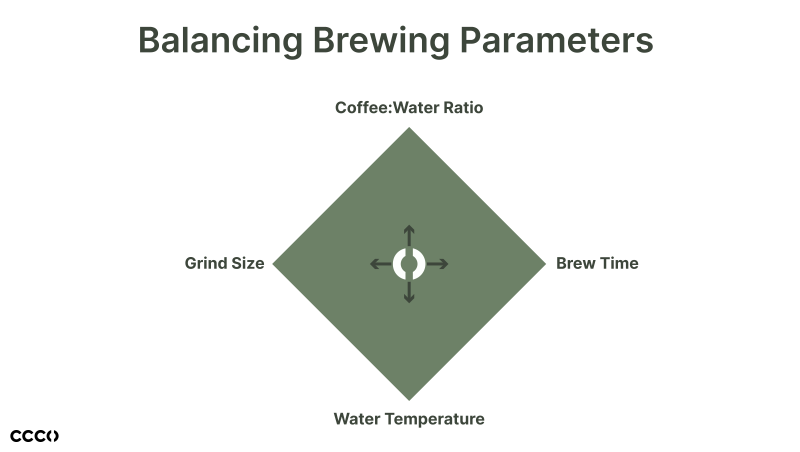
Perfecting home coffee brewing requires a balance of a few essential brewing parameters. In this article, we discuss the importance of the coffee to water ratio. Although it is a crucial parameter to consider when brewing coffee, perfecting this parameter alone will not be enough to be making cafe-quality coffee at home.
Brewing a perfect cup requires a proper coffee to water ratio, optimal water temperature, brew time, and the proper grind size adjusted to your brewing method. Check out our Coffee Grind Size Chart to learn more about the importance of coffee grinds.
You Are a Coffee To Water Ratio Expert Now!
Phew, you made it. That was a lot of information, and we hope we picked up a few tricks to share at your next party.
But remember, these are just guidelines to get you in the right ballpark. The beauty of brewing coffee at home is getting to do what you want and adjust it to your taste buds. So go ahead and experiment and make mistakes. Through trial and error is how we all figure out what we like and don’t. It’s no different when it comes to brewing the perfect coffee for ourselves.